The Challenge Of Whack A Mole Costs

The glass industry faces significant challenges, writes Mark High of Ecoglass who says it often feels like he is playing whack a mole – one problem subsides, as another springs up.
Whether it’s raw material, electricity or admin, the costs increase, the market remains at saturation and the pressure is felt throughout the supply chain. In fact, many fellow IGU manufacturers have already been pushed into the precipice. We all know the story too well – it was never one thing that tipped them over the edge. It was a culmination of multiple factors colliding at once.
The policies may be written in black and white, but the delivery of government strategy plays out in distinct shades of grey. It is rarely straightforward. And so, we find ourselves, mallet in hand, waiting to see which mole appears next.
The silver surcharge
Let’s take the recent rise in silver. To many other industries, it’s a seemingly inconsequential market activity in daily operations. For glass, however, it has shifted from a footnote to a headline issue in just a few short years. Silver experienced a record-breaking surge in 2025, with prices rising somewhere between 130 –170% within a 12-month period.
This cost flows directly into Low-E coated glass, a product we have long recommended as the ideal standard for meeting thermal efficiency targets and regulatory compliance.
Yet the very energy-efficient glass endorsed by policy and regulation is becoming increasingly expensive to produce, precisely because of the material that makes it effective. When we factor in the more advanced double- and triple-silver coated variations, which are increasingly being specified to combat unseasonably hot UK summers, we are left grappling with the balance between cost, value and viability.
Silver is not a luxury component in Low-E coatings – it is a physical necessity. There is no readily available substitute. It cannot simply be engineered out without compromising the thermal performance the product is designed to deliver. That is rarely an argument homeowners are willing to accept.
The electricity problem
‘The UK is at risk of losing its status as a major manufacturing centre after a sharp rise in energy prices that has forced about 40% of businesses to cut back investment, according to a report by the CBI and Energy UK.’ The findings, issued by the Confederation of British Industry and Energy UK, underline the mounting strain on British industry.
Since the Russian invasion of Ukraine, businesses and homeowners alike have grappled with rising energy costs. And once again, the glass industry is acutely exposed. Now conflict in the Middle East is making the energy markets even more unstable.
Tempering, processing and production all depend on high volumes of electricity, it is far from a discretionary overhead. Electricity is a core input cost, one that continues to rise uncomfortably.
As such, the ambitious government netzero targets and investment in renewables, as necessary and forward-looking as they are, offer little immediate relief at a time when the pressure is being felt most acutely.
The cumulative impact of rising raw material costs, electricity prices and increasing operational complexity is felt across the entire supply chain. Upstream, float glass manufacturers pass increased costs downstream. Fabricators, installers, and developers are left opening emails and calculating how much more they can absorb before their own viability is compromised.
Where we stand
We do not claim to have solutions that others have somehow overlooked. We are navigating the same environment as every other IGU manufacturer. We face the same silver surcharge. We pay the same energy bills. We receive the same float glass price notices. And we carry the same responsibility to our people and our customers.
What is becoming increasingly clear, however, is that this cannot continue to be treated as a private problem for individual businesses to manage in isolation. The Future Homes Standard, net zero commitments and the drive toward higher-performing, more energy-efficient buildings represent a genuine opportunity for our sector. But that opportunity risks being steadily undermined by a cost environment that makes producing the very products regulators are mandating increasingly difficult to sustain.
Industrial electricity pricing in the UK places domestic manufacturers at a structural disadvantage compared to competitors operating in lower-cost markets. That imbalance cannot be ignored indefinitely. If the government is serious about delivering Net Zero, implementing the Future Homes Standard, and protecting UK manufacturing jobs, then energy and industrial policy must align more closely with operational reality.
We do not have all the answers. But we can see the landscape for what it is, and we believe that naming the problem clearly and honestly is where we must begin, if we are to build a stronger, more resilient glass manufacturing sector that is fit for the future.
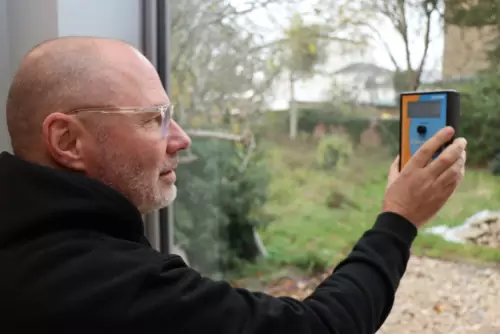
Picture: Mark High, a director at Ecoglass.
www.ecoglass.co.uk