Construction Mired By Market Maelstrom
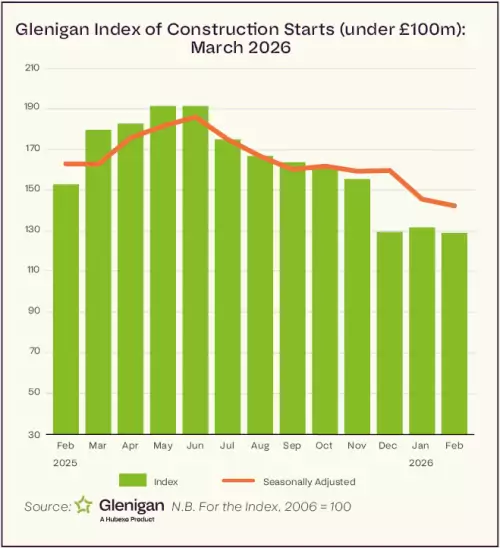
The March 2026 edition of Glenigan’s its Construction Index focuses on the three months to the end of February. It paints a bleak picture of an industry which is mired in a maelstrom.
The value of work starting on-site during the three months to February declined by 10%, stubbornly remaining 15% below 2025 levels. These disappointing results can be attributed to a number of different factors.
Struggling under immense pressure
The residential market continues to drag the sector down further. While non-residential construction saw a modest increase in performance, there was not nearly enough momentum to reverse the overall decline. As markets remain volatile, consumer confidence low and private investment lukewarm, it seems unlikely that overall recovery will be achieved in the first half of the year, according to Glenigan.
War – what is it good for?
Furthermore, recent events will likely have a significant impact on activity over the next few months. Escalating conflict in the Middle East threatens to disrupt supply chains. This would not only affect the ability for contractors to access essential construction materials, it will also have a painful operational impact as fuel and energy prices rise over the next quarter, putting extra pressure on already tight margins.
Spring statement
That’s not all. While the Chancellor has delivered a ‘steady-as-she-goes’ Spring Budget Statement with no ‘rabbits’ pulled from the hat, it may all change as conflict disrupts global trade and growth or if the UK is pulled further into military activity in the Gulf potentially affecting where budgets are spent.
As the Index shows, a high degree of uncertainty is restricting collective appetites to get Britain building again until the industry has a clearer picture of the UK’s short and long-term fiscal future.
Commenting on the relatively grim outlook, Glenigan’s Economic Director, Allan Wilen said: “Whilst non-residential construction has been a bright spot in recent months, buoyed by a growth in office, education and community & amenity work, its growth has been overshowed by declines elsewhere.
“Once again, poor residential activity has kept the flow on new projects to a meagre trickle, with exceptionally wet ground conditions during the three months to February delaying starts and contributing to the 31% drop against a year ago. It’s hoped that drier conditions in the spring will help kickstart activity. However, with a whole host of other adverse domestic and global socioeconomic challenges to surmount, we’ll need to see significant reversal in current circumstances before we see a meaningful performance uptick.”
Taking a closer look
It was another depressing Index period for residential construction with the value of starts on-site slashed by 20% and falling by almost a third (-31%), compared to 2025 figures.
Private housing declined by 22% against the preceding three months and by 36% against the previous year. Whilst housing affordability has improved over the last year, as household incomes have outpaced house price inflation and interest rates have eased, this has yet to lift new house sales. Developers remain reluctant to open up new sites until demand strengthens and are focussed on securing sales on existing sites. Furthermore, slow BSR approval of developments and wet ground conditions over the last three months have hampered project starts.
Social housing
Social housing also declined 16% against the preceding three months and by 14% against the previous year. These unimpressive numbers can largely be attributed to the long-term impact of cuts to grant funding. However, improved government support is expected to brighten sector prospects as the next Spending Review period commences from April.
Sector analysis – non-residential
Once again, offices performed particularly well, continuing on an upward trajectory first registered in late 2025. A spurt of data centre construction, which falls within this category, is one of the main reasons for this surge.
Hotel & leisure results were strong, rising by 28% against the preceding three months to stand 17% up against the previous year, with the £71 million Kings Hall Leisure Centre Clapton development helping support overall growth in the sector.
Outcomes for health were mixed. It rose 3% against the preceding three months to stand 24% lower than the previous year. Education also experienced an inconsistent period, declining 9% against the preceding three months to stand 27% up against the previous year. Both are subjects of ongoing government upgrade programmes which will potentially see activity upticks over the coming months as more assets are brought within its sphere of operations.
Retail starts were equally mercurial, increasing 13% against the preceding three months to stand 15% down against the previous year. Activity within the discount grocer niche is helping keep performance levels stable despite high street builds remaining weak.
Community & amenity project starts declined by 31% against the preceding three months to stand 21% up against the previous year, with the £91 million Newcastle Government Hub development, a standout project.
Following a relative period of growth, Industrial performance was especially poor, declining by 17% against the preceding three months to stand 10% below the previous year.
Civils work was equally unimpressive, with on-site declines down by 9% against the preceding three months and standing 20% down against the previous year.
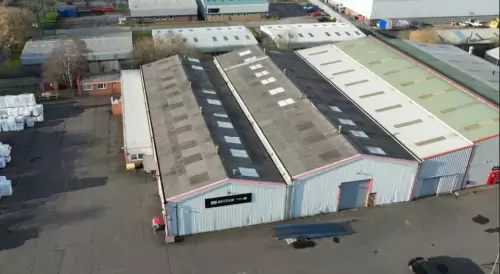
Picture: UK is stuck in a maelstrom of inactivity made worse by conflict in the Middle East.